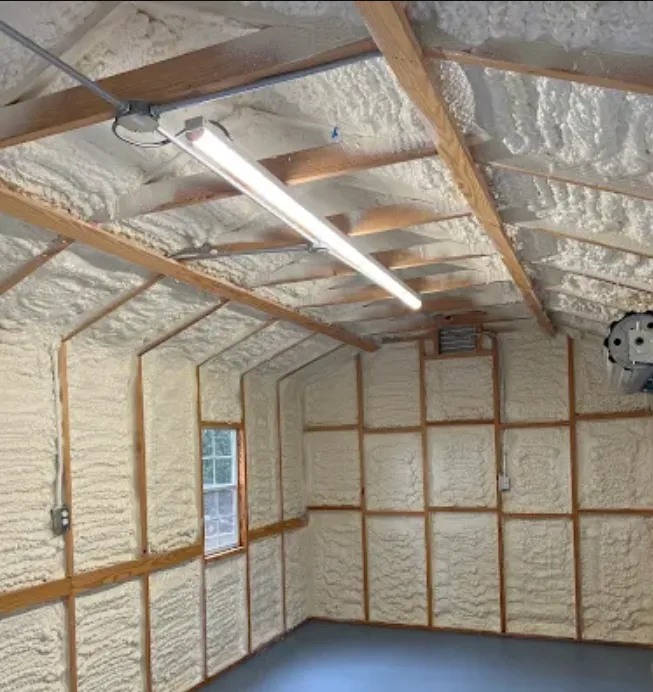
How Open-Cell Spray Foam Performs in a Hot Humid Florida Attic
Open cell spray foam in a Florida attic behaves nothing like the same material installed in Ohio. Heat, humidity, and an air conditioner running eight months a year change what the insulation is actually being asked to do.
Most attics across Marion and Volusia County reach 130 degrees by mid afternoon. The air up there carries enough moisture to make condensation a year round possibility rather than a winter curiosity.
So the useful question is not whether open cell works in principle. It is what happens to the material after five consecutive Florida summers.
There is also the matter of whether sealing the attic outright helps or quietly backfires on the rest of the house.
Why Florida Attic Heat and Humidity Break Most Insulation
A vented attic pulls outdoor air through soffit and ridge vents by design. In a dry climate that flushes accumulated heat out efficiently.
Florida air is not dry. Every hour, those vents drag humid air across ductwork and insulation sitting cooler than the surrounding attic.
Condensation then forms on surfaces never meant to get wet. Fiberglass that absorbs moisture loses R-value while damp, and repeated wetting cycles flatten it permanently.
Add ducts sweating in unconditioned space and the attic starts working against the very system it houses.
How long does ordinary insulation survive that? Usually less time than the roof above it.
How Open Cell Spray Foam Handles Moisture and Vapor
Open cell spray foam is vapor permeable, meaning moisture moves through the material rather than collecting behind it. That single property drives most of its behavior in Florida buildings.
A roof leak above the open cell shows up as a visible stain on the foam surface. The same leak above a vapor closed material can travel sideways and hide for months on end.
The trade off is that open cell does not block vapor on its own. In an attic application that is usually the entire point, because the assembly can dry toward the inside where conditioned air carries that moisture away efficiently.
What Happens When You Seal a Florida Attic with Open Cell Spray Foam
Applying foam to the underside of the roof deck converts a vented attic into conditioned space. Vents get sealed and the attic joins the home's thermal envelope.
Attic temperatures typically fall from roughly 130 degrees to within ten or fifteen degrees of indoor air. Ductwork that used to sweat all summer now sits in near conditioned surroundings.
That single change accounts for most of the energy improvement homeowners actually notice on a bill.
What changes day to day:
Air handlers stop fighting extreme attic heat all afternoon
Duct losses drop sharply across the entire system
Attic storage stops cooking every single summer
Open Cell Spray Foam Thickness and R-Value in Florida Attics
Open cell delivers roughly R-3.5 to R-3.8 per inch, so applied thickness determines performance. Florida rooflines get sprayed thicker than walls for exactly that reason.
Application | Typical thickness | Approximate R-value |
|---|---|---|
Attic roofline, conditioned attic | 5.5 to 7 inches | R-20 to R-26 |
Interior walls, sound control | 3.5 inches | R-13 |
Vaulted ceilings | 6 to 8 inches | R-21 to R-30 |
Rafter depth frequently limits how much foam can be applied without furring out the framing first. That physical constraint is one reason a field measurement tells you considerably more than a phone estimate ever will.
What Open Cell Spray Foam Costs for a Florida Attic
Open cell is priced per board foot, which equals one square foot of coverage at one inch of thickness. Thickness therefore drives the total more than floor area alone ever does.
A shallow application across a large roofline can cost less than a thick one across a small house.
Scope | Industry standard range |
|---|---|
Open cell, per board foot | $0.45 to $0.75 |
Attic roofline, installed | $1.50 to $3.00 per square foot |
1,500 square foot roofline | $2,250 to $4,500 |
These reflect regional industry averages rather than Silverback pricing. Rafter depth, access, and whether old insulation needs clearing first all move the number, so final figures follow an on-site assessment.
Book Your Open Cell Spray Foam Attic Assessment with Silverback Insulation
Whether a sealed attic suits your home depends on roof construction, duct location, and existing ventilation. None of that is answerable from a photograph or a phone call.
Silverback Insulation includes a free in person field measurement with every estimate. Our team checks rafter depth, inspects current conditions, and explains plainly whether open cell is the right call or whether another material serves you better.
Sometimes the honest answer is that your attic needs something else first.
Frequently Asked Questions
Does open cell spray foam cause mold in a Florida attic?
Properly installed open cell does not cause mold. Because it is vapor permeable, roof moisture passes through and becomes visible rather than sealing inside the assembly, which usually makes leaks easier to catch early.
Do you have to remove old insulation before spraying open cell?
In a roofline application, yes. The existing attic floor insulation is typically removed once the attic becomes conditioned space, since insulating both planes serves no purpose.
How thick should open cell spray foam be in a Florida attic?
Most Florida rooflines are sprayed between 5.5 and 7 inches, producing roughly R-20 to R-26. Rafter depth and local code requirements determine the final specification.
Does sealing an attic with spray foam void a roof warranty?
Some shingle manufacturers address unvented assemblies in their warranty terms. Checking your specific warranty before work begins is worthwhile.
How much does open cell spray foam cost for a Florida attic?
Industry averages run about $1.50 to $3.00 per square foot installed, placing a 1,500 square foot roofline near $2,250 to $4,500. Final pricing follows an on-site assessment.
We install spray foam for homeowners and commercial property owners across:
Marion County: • Ocala • Dunnellon
Volusia County: • Daytona Beach • Ormond Beach • DeLand • Lake • Helen • Orange City • Pierson • Deltona • DeBary
Flagler County: • Palm Coast • Bunnell
Lake County: • Mount Dora • Umatla • Eustis • Astor
Putnam County: • Pomona Park • Welaka
Sumter County: • Wildwood • The Villages
