How Radiant Barrier Spray Lowers Attic Temperatures in Florida Summers
Radiant barrier spray works on a completely different principle than every other product sitting in your attic. Insulation slows heat as it moves through material.
A radiant barrier does something else entirely. It reflects heat before that energy ever arrives.
That distinction matters enormously in Florida, where the dominant source of attic heat is not warm air seeping through gaps. It is radiant energy pouring off a roof deck baking at 160 degrees.
Reflect that energy back toward its source and everything underneath it has a far easier job all summer. So how much cooler does a Florida attic actually get?
Why Florida Attics Get So Much Hotter Than the Outside Air
An attic at 130 degrees on a 92 degree afternoon is not holding trapped hot air. It is absorbing radiant heat from above.
Sunlight strikes the shingles and heats the roof deck well past 150 degrees. That deck then radiates energy downward onto everything below it, including ducts, stored belongings, and insulation.
Radiant heat needs no air movement to travel. It crosses open space instantly, which is why ventilation alone never solves the problem.
Adding more insulation on the attic floor slows the transfer but does nothing to reduce the radiant load arriving overhead. Why fight heat you could reflect instead?
How Radiant Barrier Spray Reflects Heat at the Roof Deck
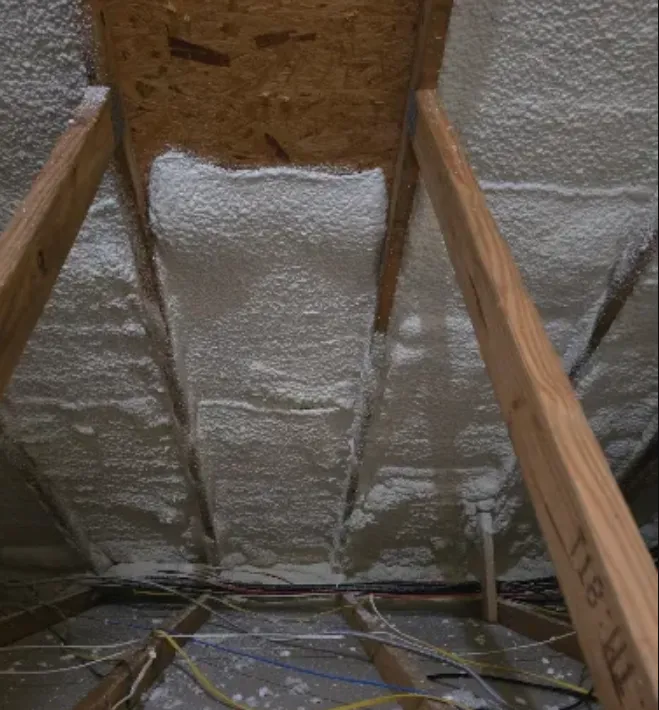
Radiant barrier spray is a reflective coating applied to the underside of the roof decking and rafters. Once cured, it forms a low emissivity surface facing down into the attic.
That surface reflects a substantial share of radiant energy back toward the roof rather than releasing it into the attic below.
The application reaches places sheet foil struggles with. Spray follows the decking around plumbing stacks, wiring runs, bracing, and the awkward geometry every Florida roof contains.
Coverage therefore stays continuous across the entire plane. That continuity determines real world performance far more reliably than any single product specification on a data sheet.
How Much Radiant Barrier Spray Lowers Attic Temperatures
Measured results depend on roof color, pitch, ventilation, and how much sun the roof takes. Still, the pattern is consistent enough to describe honestly.
A drop of 20 to 30 degrees is a reasonable expectation on a sun exposed Florida roof. Ductwork and air handlers sitting in that space feel the difference immediately, which is where most of the energy benefit actually comes from.
Where Radiant Barrier Spray Works and Where It Does Not
A radiant barrier earns its place when radiant heat is the dominant problem. It is not a substitute for insulation, and any contractor selling it that way is overstating the case considerably.
Knowing which category your building falls into saves money before anyone quotes anything.
Strong candidates:
Attics with ductwork or air handlers in the unconditioned space
Homes with dark shingles and heavy afternoon sun exposure
Warehouses, workshops, and pole barns with metal roof decks
Attics used for storage that currently cook every summer
Weaker candidates:
Rooflines heavily shaded for most of the day
Attics where the floor insulation is failing and should be addressed first
What Radiant Barrier Spray Costs in Central Florida
Radiant barrier spray is priced by the square footage of roof deck surface rather than by attic floor area. Steeper pitches therefore carry considerably more surface than the building footprint suggests.
Two houses with identical floor plans can quote differently on roof geometry alone.
These are regional industry averages rather than Silverback pricing. Roof pitch, attic access, obstructions, and prep requirements all shift the figure, so a final quote follows an on-site assessment.
Ask Silverback Insulation About Radiant Barrier Spray for Your Attic
Whether a radiant barrier is your best next move depends on what is already up there. An attic with failing floor insulation has a more urgent problem to solve first.
Silverback Insulation includes a free in person field measurement with every estimate. Our team looks at roof construction, duct placement, sun exposure, and current insulation condition before recommending anything.
Frequently Asked Questions
Does radiant barrier spray replace attic insulation?
No. A radiant barrier reflects radiant heat while insulation resists conductive heat transfer. They address different mechanisms, and the best results usually come from having both working together.
How much does radiant barrier spray lower attic temperature?
On a sun exposed Florida roof, a 20 to 30 degree reduction at peak afternoon temperature is a reasonable expectation. Roof color, pitch, and ventilation all affect the result.
Is radiant barrier spray better than foil radiant barrier?
Spray achieves continuous coverage around obstructions that sheet foil cannot easily follow. Foil offers slightly higher reflectivity on clean flat runs. Attic geometry usually decides which performs better in practice.
Does radiant barrier spray work on a metal roof?
Yes, and metal decks are often the strongest candidates. Metal heats fast and radiates aggressively, so warehouses and workshops typically see pronounced temperature drops.
How much does radiant barrier spray cost in Central Florida?
Industry averages run roughly $0.35 to $0.75 per square foot of roof deck, placing a typical 1,500 square foot attic near $700 to $1,400. Final pricing follows an on-site assessment.
Sometimes the honest answer is that a different service delivers more for your money. We serve homeowners and commercial property owners across:
Marion County: • Ocala • Dunnellon
Volusia County: • Daytona Beach • Ormond Beach • DeLand • Lake • Helen • Orange City • Pierson • Deltona • DeBary
Flagler County: • Palm Coast • Bunnell
Lake County: • Mount Dora • Umatla • Eustis • Astor
Putnam County: • Pomona Park • Welaka
Sumter County: • Wildwood • The Villages
